
Whispers from the West Wing: Unpacking the Madeleine Westerhout Allegations

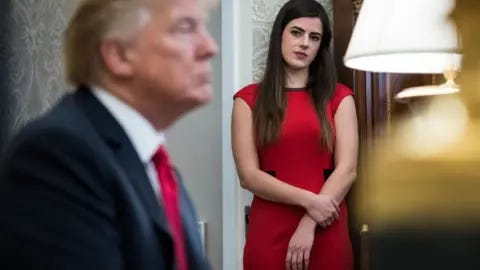
In the high-stakes theater of American politics, where power dynamics often blur the lines between professional duty and personal indulgence, few stories capture the public’s imagination quite like whispers of an illicit affair in the Oval Office.
The latest chapter in this enduring saga emerged just weeks ago, on November 15, 2025, when a trove of over 23,000 documents from Jeffrey Epstein’s estate was handed over to Congress. Buried within was a 2019 email from controversial author Michael Wolff to the late financier, alleging that then-President Donald Trump boasted to friends about “banging” his 28-year-old White House assistant, Madeleine Westerhout, during the 2018 government shutdown.
As Trump settles into his second term, these resurfaced claims have reignited debates about credibility, evidence, and whether such indiscretions truly matter in the corridors of power.
The story traces back to a lonely White House Christmas in 2018. With the federal government shuttered amid a budget standoff, Trump opted to stay in Washington while First Lady Melania decamped to Mar-a-Lago with their son Barron and extended family.
In a draft excerpt from his forthcoming book Siege, shared with Epstein, Wolff painted a vivid, if salacious, picture: Westerhout, Trump’s personal secretary and director of Oval Office operations, allegedly delivered documents to the residence, finding the president in his underwear. Wolff claimed Trump leered approvingly—“She’s got a way about her”—before confiding to confidants that his shutdown vigilance was a cover for their liaison.
“Now the president was telling friends that he wasn’t staying at the White House because of the shutdown—he was staying because he was ‘banging’ Madeleine,” the email read. This passage was scrubbed from the published version of Siege, anonymizing the aide, but the Epstein files laid it bare.
Westerhout, now 35 and a steadfast Trump loyalist who penned a 2020 memoir praising her former boss, wasted no time in rebuttal. Through her lawyer, she branded the claims “absurd and defamatory,” dismissing Wolff as a “discredited writer who has been known to peddle falsehoods.” The White House echoed this, with press secretary Karoline Leavitt calling it a “Democratic hoax” amplified by media oxygen. Trump himself has remained characteristically mum, though his history of deflection—labeling similar Epstein-linked scrutiny as “fake news”—suggests little will dent his armor.
So, how credible is this? On balance, the evidence stacks thinly against the allegation, rendering it more smoke than fire. Wolff, whose books Fire and Fury and Siege have chronicled Trump’s orbit with insider scoops but also faced plagiarism accusations and factual disputes, relies here on unnamed “friends” for his narrative.
No corroborating witnesses, documents, or recordings have surfaced in the six years since the alleged events, nor in the Epstein trove beyond this solitary email. Epstein, a convicted sex trafficker with his own axes to grind against elites, adds a layer of taint—why share such dynamite with him if not to curry favor or fabricate leverage?
Westerhout’s denial carries weight; as a key aide fired in 2019 for off-the-record gaffes about the Trump daughters (she bragged of a closer bond to Trump than Ivanka or Tiffany), she had every incentive to spill if true, yet her memoir Off the Record omits any hint of romance. Social media buzz, from viral YouTube shorts to X threads, amplifies the drama but offers zero new proof—mostly partisan sniping or memes. In a post-#MeToo era, absent consent affirmations or victim testimony, this reads as vintage Wolff provocation: tantalizing, but unverified.
Yet, even if we entertain the possibility—and Trump’s own admissions of marital lapses in the Access Hollywood tape lend it a whiff of plausibility—why feign outrage? Affairs among the powerful are as old as the Republic itself, from Jefferson’s dalliances to Kennedy’s escapades. For the President of the United States, the Oval Office is a pressure cooker of 24/7 demands, where proximity breeds intimacy and testosterone-fueled decisions define legacies.
History brims with leaders juggling mistresses amid conquests; it’s practically a perk of the pantheon. This one, if real, was consensual—Westerhout, a sharp, ambitious operative, wasn’t some ingénue coerced by hierarchy. At 28, she was a grown woman navigating the same cutthroat arena as her boss, and mutual attraction in isolation (an “empty White House,” per Wolff) hardly screams scandal.
Consider Trump’s family: Melania, ever the poised Slovenian enigma, has weathered Stormy Daniels, Karen McDougal, and tabloid tempests without a public flinch. Their son Barron, now 19, thrives under the spotlight; Ivanka and Jared Kushner parlayed White House access into billions. As long as Trump continues to protect and provide—securing borders, slashing taxes, stacking courts—familial fractures fade into irrelevance.
Critics clutch pearls over optics, but pragmatics prevail: his net worth balloons, his brood’s influence endures. Evolutionary lens sharpens this further; religion and monogamy norms arose not from moral purity but resource scarcity. Pre-modern men couldn’t juggle harems without diluting provisions—starving one hearth to feed another. In Trump’s era of abundance, where one mogul’s empire sustains multiple orbits, such constraints dissolve. Why condemn a provider who elevates all boats?
In the end, these allegations, credible or not, underscore a timeless truth: Power’s gravitational pull warps propriety, but it also forges titans. Trump, twice-elected colossus, has outlasted impeachments, indictments, and innuendos. If a shutdown tryst was his sole vice, it’s a footnote in a presidency rewriting America’s arc. The real scandal? That we’re still transfixed by the man in underwear, not the empire he builds. As the Epstein files gather dust and X erupts in echo chambers, one wonders: In the White House game, is the dalliance the story, or merely the distraction?